

Quitting a job is one of the biggest professional decisions you’ll make. Do it the right way and you leave with your reputation intact, strong references, and a clear path to your next role. Do it the wrong way and the fallout can follow you for years.
This guide walks you through exactly how to quit a job in 2026 the way US career experts recommend: smart timing, a clean resignation, a professional exit, and — most importantly — a solid next step already lined up before you hand in your notice.
Before you quit, make sure you have something better waiting. Browse fresh USA job listings on JobZee.online or search directly on Indeed.com to start finding your next role today. The U.S. Department of Labor also has resources on workers’ rights and benefits during job transitions.
PRO TIP Never quit a job without having your next move planned. Studies show employed job seekers get better offers, faster callbacks, and higher starting salaries than those who quit first.
Part 1: Before You Quit a Job — Critical Steps to Take First
Knowing how to quit a job starts well before you write the resignation letter. These ten steps protect your finances, your benefits, and your professional reputation before you ever say the words out loud.
1.1 Secure Your Next Job Before You Resign
The single most important step in figuring out how to quit a job is having an offer in hand first. Quitting without one forces you into a rushed job search from a weaker negotiating position. Most employers move faster and pay more when hiring candidates who are currently employed. Browse open roles now on JobZee.online to start your search while still employed.
1.2 Understand Your Financial Runway
Before you commit to quitting, calculate how many months of expenses you can cover without income. Financial advisors typically recommend three to six months of savings as a safety net. If you’re leaving without a new offer, this number determines how long you can job search without desperation influencing your decisions.
1.3 Review Your Employment Contract
Many US employment agreements include non-compete clauses, non-disclosure agreements (NDAs), or IP assignment clauses that survive your resignation. Before you finalize how to quit a job, review your contract carefully — or consult an employment attorney — to understand what you’re bound by after you leave.
1.4 Check Your Benefits and Vesting Schedule
Timing your resignation around benefits can mean significant money. Check: when does your next PTO payout happen, when does your 401(k) employer match fully vest, and when is your next bonus paid. A two-week delay in your last day can sometimes be worth thousands of dollars in benefits you’d otherwise forfeit.
1.5 Know Your Health Insurance Situation
Losing employer health insurance is one of the most practically disruptive parts of quitting a job. In the USA, you have 60 days after losing coverage to enroll in a new plan through the Health Insurance Marketplace under COBRA or ACA options. Research your plan options before you resign so there’s no coverage gap.
1.6 Understand Your Unemployment Eligibility
If you voluntarily quit, you are generally not eligible for unemployment benefits in most US states. However, if you’re quitting due to hostile work environment, constructive dismissal, or medical reasons, you may qualify. Check your state’s specific rules on the U.S. Department of Labor website before assuming you’ll receive benefits.
1.7 Identify References Before You Leave
Decide which colleagues and managers you want as references before you hand in your notice. Once you resign, workplace dynamics shift quickly. Ask trusted colleagues informally if they’d be comfortable serving as references. Strong references are one of the most valuable things you take with you when you know how to quit a job well.
1.8 Back Up Your Personal Files and Contacts
Before your last day, gather any personal files, projects, or portfolio items that belong to you (not company IP). Export your professional contacts from your work email if your company’s policy permits. Once your IT access is revoked, retrieving this information becomes very difficult or impossible.
1.9 Decide on Your Notice Period
The US standard notice period is two weeks, but this varies by role and seniority. Senior roles often require 30 days. Leadership positions may require 60 days or more. Check your contract. Even if no notice is required, giving appropriate notice is one of the most important parts of how to quit a job gracefully.
1.10 Prepare Emotionally for the Conversation
Many people dread the resignation conversation because they feel guilty or anxious about letting their manager down. Prepare by rehearsing what you’ll say, keeping your statement brief and positive, and deciding in advance not to be talked out of leaving. Your decision is valid. The conversation will be shorter and easier than you expect.
Standard Notice Periods in the USA by Role Type:
Role / Seniority Level | Typical Notice Period | Contract Requirement? | Best Practice |
|---|---|---|---|
Entry-level / Hourly | 1–2 weeks | Rarely required | Give 2 weeks as courtesy |
Mid-level professional | 2 weeks | Sometimes specified | 2 weeks minimum always |
Senior / Team Lead | 3–4 weeks | Often specified | Check contract + discuss |
Manager / Director | 4–6 weeks | Usually specified | 30 days strongly preferred |
VP / C-Suite / Executive | 60–90 days | Almost always stated | Honor fully; negotiate if needed |
Technical / Specialized | 2–4 weeks | May have handoff req. | Complete key handoffs in writing |
Notice periods are professional norms, not legal requirements in most US states (at-will employment states). Always check your specific contract for binding clauses.
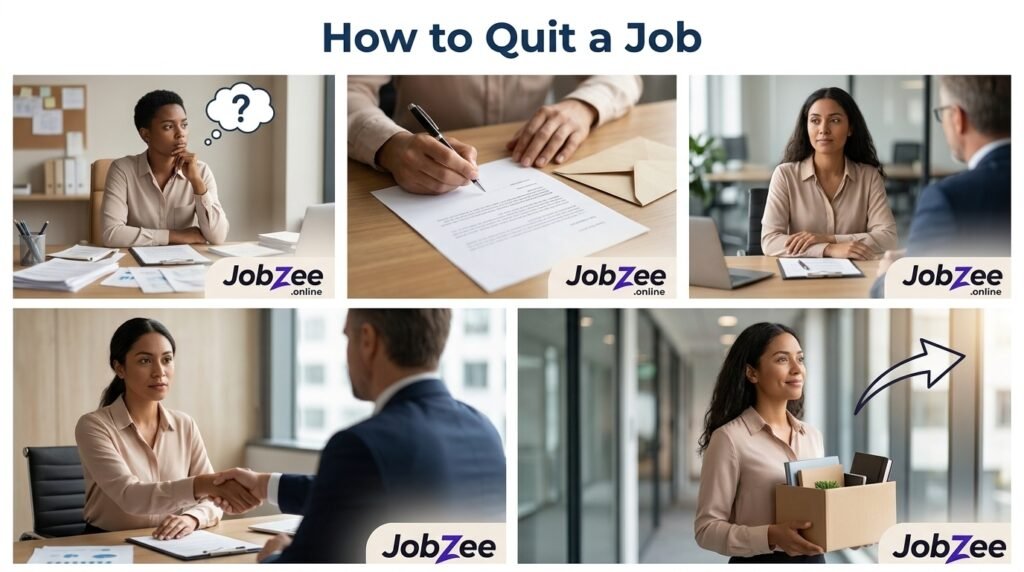
Part 2: How to Quit a Job the Right Way — Step by Step
Once your preparation is complete, the actual process of quitting comes down to a clear sequence of actions. Follow these ten steps and you’ll know exactly how to quit a job in a way that earns respect and preserves every professional relationship that matters.
2.1 Choose the Right Time to Resign
Timing matters when quitting a job. Avoid resigning: on a Monday (disrupts the full week), right before a major deadline or product launch, or during a colleague’s crisis or leave. The best time is mid-week (Tuesday or Wednesday), when workloads are steady and your manager has time to process the news and begin planning.
2.2 Have the Conversation in Person (or Video Call)
Always tell your direct manager before anyone else — in person or via video call if you’re remote. Do not resign by email first. The in-person conversation shows professional respect and gives your manager the opportunity to respond with dignity. The email resignation letter comes after the verbal conversation, not before it.
2.3 Keep the Conversation Short and Positive
When you tell your manager you’re resigning, keep the conversation to two to three minutes. Say: you’ve decided to resign, your last day will be [date], and you’re committed to a smooth transition. Do not elaborate on why unless asked directly. Do not list grievances. The conversation about how to quit a job well is intentionally brief.
2.4 Write a Professional Resignation Letter
A resignation letter is an official document that protects you legally and formally starts the clock on your notice period. Keep it to three short paragraphs: your intention to resign, your last day, and a sentence expressing gratitude for the opportunity. No need to explain why you’re leaving, criticize the company, or make promises you can’t keep.
2.5 What NOT to Say When You Quit
The moment you resign, everything you say becomes part of your professional permanent record. Avoid: complaining about your manager, salary, or colleagues; making comparisons to your new employer; threatening to take clients with you; or demanding a counter-offer conversation in the same meeting. Learning how to quit a job gracefully is largely about what you don’t say.
2.6 Negotiating a Counter-Offer: Should You Stay?
If your employer makes a counter-offer, research shows that the majority of employees who accept one still leave within 12 months anyway — because the underlying reasons for wanting to leave haven’t changed. Evaluate counter-offers carefully. If your reasons for leaving are about growth, culture, or management, more money rarely fixes them.
2.7 Create a Handover Document
A professional transition plan is one of the most generous things you can do when quitting. Create a written document covering: your active projects and their status, key contacts and client relationships, recurring tasks and deadlines, login or system information (where appropriate), and any context a successor will need. This is the mark of someone who truly knows how to quit a job well.
2.8 Train Your Replacement or Team
If time permits, offer to train a colleague or help onboard your replacement. Even a few hours of knowledge transfer saves your team significant time. This act of generosity is remembered long after you’ve left and often leads to future referrals, freelance opportunities, or glowing reference calls.
2.9 Finish Strong in Your Final Weeks
The last few weeks on a job define how people will remember you. Arrive on time. Complete assigned work. Stay off your personal phone while on the clock. Avoid “short-timer’s syndrome” — mentally checking out before your last day. Companies have long memories, industries are small, and former colleagues often reappear as future clients, managers, or hiring decision-makers.
2.10 Leave on Good Terms with Everyone
Say genuine personal goodbyes. Send short, warm emails to colleagues who mattered. Connect on LinkedIn before your last day. Return all company property promptly. Your last day on a job is the most powerful impression you’ll leave with that organization — make it count.
How to Quit a Job: Do vs. Don’t Checklist:
✅ Do This | ❌ Never Do This |
|---|---|
Tell your manager in person (or video call) first | Send a resignation email without a conversation first |
Give the standard notice period for your role | Quit effective immediately (unless safety or legal issue) |
Write a brief, professional resignation letter | List grievances or criticisms in your letter |
Create a written handover document | Leave without documenting your responsibilities |
Connect with key colleagues on LinkedIn before you leave | Bad-mouth the company or manager on social media |
Return all company equipment on or before your last day | Take company property, data, or IP with you |
Finish all assigned work during your notice period | Check out mentally and coast through your last weeks |
Thank people who helped your career there | Make promises about staying in touch you won’t keep |
Accept goodbye well wishes graciously | Reveal where you’re going if you’d prefer not to |
Ask for a reference from 1–2 trusted colleagues | Expect a glowing reference after burning bridges |
Part 3: After You Quit — Protecting Your Career and Landing What’s Next
Quitting is only the beginning. What you do in the days and weeks after you leave determines how quickly you move forward. These ten steps ensure your career momentum doesn’t just survive the transition — it accelerates.
3.1 Start Your Job Search Immediately If You Haven’t Already
If you quit without an offer in hand, start your active job search on day one. Every week of delay costs you momentum and negotiating power. Browse USA job listings by category at JobZee.online — organized by niche so you find relevant opportunities fast — and set up daily alerts on Indeed.com for your target role titles.
3.2 Update Your Resume Before Your Last Day
While your job duties, accomplishments, and metrics are fresh in your mind, update your resume before your last day. Add measurable outcomes to every bullet point. Waiting weeks after quitting means you’ll forget the specific numbers — and numbers are exactly what makes a resume competitive in 2026.
3.3 Update LinkedIn Within 48 Hours of Your Last Day
Update your LinkedIn end date promptly and either add your next role (if you have one) or set your profile to “Open to Work.” Recruiters browse LinkedIn daily for available talent — a stale profile with an old end date makes you invisible to people actively trying to hire you.
3.4 File for Unemployment Benefits If Eligible
If you were laid off (not if you voluntarily resigned), file for unemployment benefits immediately — most states require filing within seven days of your last day to receive full benefits. Visit your state’s labor department website or the U.S. Department of Labor for filing links and eligibility rules by state.
3.5 Address the Gap on Your Resume Honestly
A short gap between jobs is normal and rarely hurts your candidacy in 2026. Be prepared to explain it briefly and positively in interviews: “I left to pursue a role that better matched my skills and career goals” is sufficient. Never lie about dates or invent freelance work to fill a gap — background checks are thorough.
3.6 Reach Out to Your Network Immediately
More than 70% of US job openings are filled through professional networks before they ever appear on job boards. Within the first week after quitting, contact five to ten former colleagues, managers, or clients — not to ask for a job directly, but to reconnect and mention you’re exploring new opportunities. This one habit shortens job searches dramatically.
3.7 Negotiate Your New Salary with Full Information
Whether you have an offer or you’re still searching, research salary benchmarks now using the BLS Occupational Outlook Handbook and Indeed’s salary tool. Candidates who research compensation before negotiating consistently receive 10–18% higher offers than those who accept the first number presented.
3.8 Protect Your Mental Health During the Transition
Job transitions are among the most stressful events in adult life, even when they’re chosen freely. Establish a daily routine during your search: fixed start times, scheduled breaks, and clear end-of-day boundaries. Treating your job search like a job — with structure and rest — produces better outcomes and protects your wellbeing.
3.9 Stay in Touch with Former Colleagues Professionally
The colleagues you worked with are your most valuable professional assets. Send a brief, personal email to five to ten people in your first week after leaving. Engage with their LinkedIn posts. Congratulate them on milestones. Relationships maintained are references, referrals, and future opportunities. Most people neglect this step entirely.
3.10 Reflect on What You Want Before Saying Yes
Before you accept the first offer that comes, take 24–48 hours to evaluate it against what you actually want: salary, culture, growth, flexibility, and management quality. The same impulse that made you learn how to quit a job gracefully should make you thoughtful about which opportunity you choose next. Browse role-specific career guides and job listings on JobZee.online to make sure you’re comparing the full range of options.
READY FOR YOUR NEXT MOVE? Browse fresh USA job listings by category on JobZee.online — Remote jobs, HR, Accounting, Digital Marketing, Nursing, and more. All listings link directly to Indeed.
Post-Resignation Action Checklist — Week by Week:
Timeframe | Action | Priority |
|---|---|---|
Before last day | Update resume with current metrics and accomplishments | Critical |
Before last day | Connect with key colleagues on LinkedIn | High |
Before last day | Complete and share handover document | Critical |
Before last day | Back up personal files and contacts (company policy permitting) | High |
Day 1 after | Update LinkedIn profile (end date + Open to Work if needed) | Critical |
Day 1 after | File for unemployment if eligible (laid off, not quit) | Critical |
Week 1 | Begin active job search on JobZee + Indeed with daily alerts | Critical |
Week 1 | Contact 5–10 network connections to announce availability | High |
Week 1–2 | Research salary benchmarks for target roles (BLS + Indeed) | High |
Ongoing | Apply daily, follow up after 5–7 days, track applications | Critical |

Final Thoughts
Knowing how to quit a job correctly is a career skill that pays dividends for decades. The employees who leave gracefully — with a proper notice, a thoughtful handover, and genuine goodbyes — consistently report stronger references, broader networks, and faster paths to their next opportunity than those who leave poorly.
The best next step? Make sure you have something great to move toward. Explore USA job listings by category — remote, HR, accounting, digital marketing, nursing, tech, and more — at JobZee.online. And for official information on your rights during a job transition, visit the U.S. Department of Labor.